
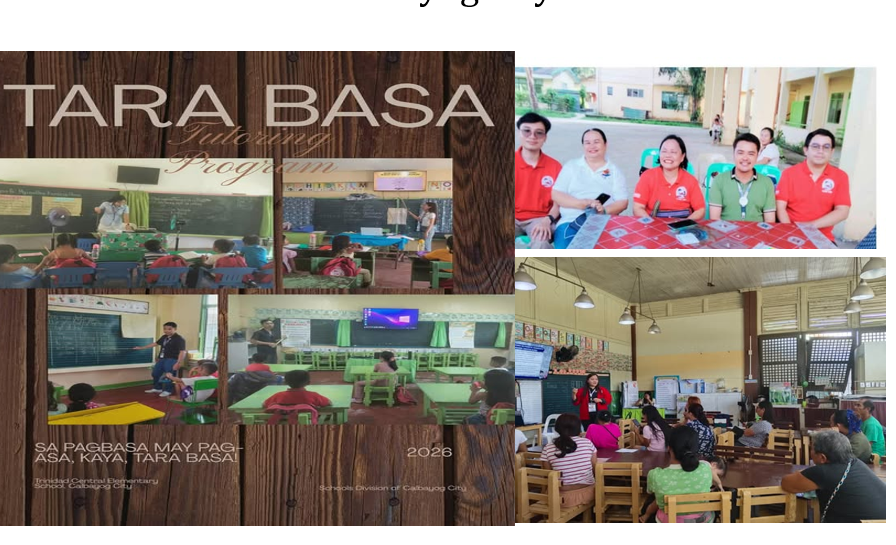
Date: APRIL 15, 2026 TO MAY 15, 2026
Part I: Background Information
- Rationale of the Program/Activity
The Tara, Basa! Tutoring Program is a flagship initiative of the Philippine government designed to create a “learning ecosystem” that addresses reading difficulties among elementary school students while supporting the financial needs of college students. Launched by the Department of Social Welfare and Development (DSWD) in partnership with the Department of Education (DepEd), it acts as a reformatted version of the government’s traditional educational assistance.
The program is unique because it simultaneously helps three distinct groups of people:
1.Struggling Elementary Learners: The primary targets are young public-school pupils (mostly incoming Grade 2 students) who are slow readers or non-readers. They receive a 20-day intensive reading tutorial during school breaks.
2. Low-Income College Students: Third and fourth-year students from State Universities and Colleges (SUCs) and local government-run schools are hired as tutors or Youth Development Workers (YDWs). This uses a cash-for-work scheme, allowing college students to earn the regional minimum wage to pay for their education while giving back to the community.
3. Parents and Guardians: The program believes that learning starts at home. Parents attend special Nanay-Tatay (Mother-Father) Teacher sessions to learn how to guide their children’s reading. They also receive a small daily cash allowance (around ₱235) for attending sessions and preparing their child’s learning needs.
Calbayog City division is one of the many recipients of the said program from Fiscal year 2024, 2025 and 2026. For this year , Calbayog City Division has a total of 690 beneficiaries of the Tara-basa tutoring program this includes 138 tutors and 69 Youth development workers for Nanay-tatay Tutoring sessions. The 630 beneficiaries were from 33 schools.
- The Objectives of the Activity/Program
General Objectives:
The primary objective of the Tara, Basa! Tutoring Program is to reduce learning poverty and provide social protection to low-income families by building a supportive learning ecosystem.
Specific Objectives:
. 1. Improve the Reading Skills of Young Learners Boost Literacy:
a. Help public elementary school students who are non-readers or struggling readers catch up with their peers;
b. Teach the Basics;
c. Build foundational skills like letter sounds, word recognition, and reading comprehension;
d. Prevent Learning Dropouts;
e. Give kids the confidence to stay in school by fixing reading problems early.
2. Empower and Support Low-Income College Students
` a. Provide Financial Help: Lower the financial burden on college students through a cash-for-work program, helping them stay in school.
b. Build Work Skills: Train future graduates in leadership, public speaking, communication, and basic teaching methods.
c. Encourage Nation-Building;
d. Give the youth an active role in helping their local communities grow.
3. Strengthen the Capacity of Parents and Guardians
a. Build “First Teachers”: Train parents through Nanay-Tatay (Mother-Father) sessions to guide their children’s learning at home.
b. Ease Financial Stress: Give parents cash assistance for participating, helping them provide for their family’s daily needs.
c. Promote Child Protection: Teach families about positive parenting, child care, and protecting children’s right
4. Create Stronger Community Partnerships
a. Unite Government and Schools
b. Connect national agencies, local governments, and universities to work together.
c. Build Lasting Support Systems
d. Ensure that a child’s family, school, and community are all actively working together to keep kids learning.
- Expected Outcome and Results
For Elementary School Learners
- Massive Upward Movement in Literacy: Over 80% of assessed learners in Filipino and 65% in English successfully reached the developing stage and meets expectation stage.
- Reduction in Severe Learning Gaps: The program effectively saved six hundred thirty learners basing from reading skills status from book and blending to reading comprehension
- Summary Profile of Participants
- Schools and number of beneficiaries
| No. | School | No of beneficiaries | School head |
| 1. | Naga ES | 10 | Cris Llego |
| 2. | Salhag ES | 10 | Janice Jose |
| 3. | Bante ES | 10 | Adora Montanez |
| 4. | Sinidman Occ. ES | 10 | Berly Manzanero |
| 5. | Mag-ubay ES | 10 | Dondon S. Ale |
| 6. | Danao 1 ES | 20 | Merardo Comayingking |
| 7. | Lonoy IS | 20 | Rafael Mente |
| 8. | Basud IS | 20 | Norman Sagayap |
| 9. | Trinidad CES | 30 | Zenaida Saavedra |
| 10. | San Policarpo CES | 30 | Dr. Jaime Millamis |
| 11. | Anislag ES | 20 | Rodrigo Ventures Jr. |
| 12. | Cagsalaosao ES | 20 | Sara Demit |
| 13. | Tinambacan CES | 30 | Michael Pernia |
| 14. | Malajog IS | 10 | Danilo Jadulco |
| 15. | Amampacang ES | 10 | Maychie T. Batulat |
| 16. | Malopalo ES | 10 | Merlita Anora |
| 17. | Oquendo CES | 20 | Nimfa S. Doroja |
| 18. | Begaho ES | 10 | Lailanie Apes |
| 19. | Calb. East CES | 30 | Samila Advincula |
| 20. | Nijaga ES | 20 | Crisanto Pacho |
| 21. | Hamorawon ES | 20 | Myrna Resulta |
| 22. | Calb. City SPED center | 20 | Dioleriano Cacait Jr. |
| 23. | Dagum ES | 30 | Cynthia Pagatpat |
| 24. | Matobato ES | 20 | Dr. Bonifacio Pondang |
| 25. | Carmen ES | 20 | Norman Cabugawan |
| 26. | Bagacay IS | 20 | Luz T. Uy |
| 27. | Capoocan ES | 30 | Danilo Merales |
| 28. | Cogon ES | 10 | Chona Valenzuela |
| 29. | Obrero ES | 20 | Leona Yulo |
| 30. | Caballero ES | 10 | Jovie Bido |
| 31. | Carayman ES | 20 | Lea Jordan |
| 32. | Rawis ES | 10 | Carmen Lourdes Tan |
| 33. | Calb. Pilot CES | 30 | Nova S. Gaspan |
Part II:
- Highlights of the Activity
1. Call-ups from DSWD for orientation of the Program at Tacloban City
2. Training of trainers for the tutors and YDW at Tacloban City
3. Meeting with school heads of beneficiaries
4. Conduct of training for the tutor and YDW
5. Pre-deployment activity with school heads, tutors, YDW DSWD and NWSSU
6. Kick-off activity
7. 20-day tutoring and Nanay-tatay Tutorial Program
8. Culmination Program
B. Key Learnings
1. To champion literacy it needs a collaboration from other agencies
2. The support of the school heads of the identified schools contributed to the success of the 3rd year implementation of the Tarabasa Program
3. The unending support of the office of the governor of the Province of Samar made the program improve year by year.
4. The collaboration of NWSSU and Department of Education paved way for the successful implementation of the Tara-basa tutoring program
5. The intensive monitoring of the DSWD personnel assigned contributed much in addressing immediate concerns in its implementation
6. as the program is in its 3rd year implementation, all the concerned agencies work hand in hand to ensure that the purpose of the program will not put into vain.
- Issues and Concerns
The issues and concerns arise during the sessions are as follows.
First, the mismatch of the NWSSU vacation and the DepEd. This issue has been addressed by NWSSU by selecting only 2nd and 3rd year students at the most.
Second, some learners may not be in the same level with the materials. This issue has been addressed by asking technical assistance to the teacher in-charge as to the materials suited to learners with mismatch of the materials level.
Third, the Brigada Eskwela falls on tutorial session days. This issue was addressed by letting the teachers do the Brigada Eskwela in the afternoon while the tara-basa tutorial class will be in the morning.
Fourth, as YDW are not so much experienced when it comes to parental sessions, the schools let the YDW use televisions for television-aided sessions.
Lastly, Due to 30-day undisturbed vacation of teachers, all school heads directly supervised the 20-day Tarabasa sessions with the assistance of the Administrative officers and COS in case the school head is on travel.
- Synthesis
The Tara, Basa! Program is a valuable resource for improving the reading comprehension skills of Filipino students. It is based on the principles of effective literacy instruction and uses a variety of materials and activities to engage students in the learning process. The program is expected to be effective in improving the reading comprehension skills of Filipino students in public schools initiated by the Department of Social Welfare and Development (DSWD). This is designed to promote early literacy and improve the reading skills of Filipino children as well as strengthen community support through the tutorial sessions by the learning facilitators trained by education experts tapped by DSWD for this project.
Calbayog City Division has 630 learners and parents beneficiaries coming from the 33 schools/barangays. The beneficiaries of the program are the struggling learners or low emergent learners in Grade One (1) from the School Year 2025-2026 or the incoming Grade Two (2) pupils. Positive results of this intervention was of great help not only for the parents and their children but also for the teachers in Grade Two as poor reading skills will no longer be a problem since the same interferes with the learning process in the classroom activities. The parents and the learners were handed the invitation during the report card distribution where parental consent forms were also given which they would submit back to the Office as part of the documentary requirements.
The program is being implemented in close coordination with the Department of Education. Tara, Basa! is expected to give a significant and positive outcome in literacy after a month of fulfilling hard work and dedication. It forms part of the learning recovery plan due to the learning loss incurred during the pandemic. With this program, the grade one learners who are incoming grade two for the SY 2026-2027, are expected to be at least proficient in reading and comprehension. Since parental involvement is one of the key factors for the success of this reading intervention, DSWD has allocated the funds for the youth and the family who will be involved in the program. It can be said that some reading intervention strategies turned out to be inefficient as parents could not sustain the activities needed by the children because either they do not have the knowledge to do it or they do not have the time to commit to supporting the children.
The strategy that stands out among the others is one-on-one tutoring which the Tara, Basa! Program will utilize. When the parents understood their responsibility and the financial aid that awaited them, they readily gave their consent to experience the teaching and learning process first-hand. Teaching reading is a complex and challenging task, but it is also one of the most important things that can be done for the children, with the partnership between teachers and parents in the Tara, Basa! Program. It is hoped that the collective effort will yield a significant increase in the reading proficiency skills of the identified learners.
As we ended the 3rd year implementation of the Tara-basa, the Department of education is committed to continue to support the programs and project of the Office of the governor of Samar with the partnership of any agencies towards improving the life of the learners and the communities of the Calbayog City. The school’s division also expresses commendations to DSWD for this excellent program. Indeed, as it takes a village to educate a child, there is no sincere and excellent efforts as this program- helping the education sector and improving youth responsibility in transforming communities.
Prepared by:
LOURDES L. MATAN
EPS-Tarabasa Coordinator
